Small Business SEO in 2026: What Actually Works (And What's a Waste of Money)
A no-nonsense guide to small business SEO in 2026. What tactics actually drive results, what wastes your money, and how long it really takes.
Most SEO advice online is written for people with marketing teams and five-figure monthly budgets. If you're a small business owner doing this yourself (or trying to figure out if hiring an agency is worth it), you need a different playbook.
I've worked on SEO for small businesses for years. Some strategies move the needle fast. Others are a complete waste of time and money. Here's how to tell the difference.
What still works in 2026
Google Business Profile (free, high impact)
If you serve customers in a specific area, your Google Business Profile is more important than your website for local searches. When someone searches "plumber near me" or "best coffee shop in [city]," Google shows the map pack first. Your website ranking doesn't matter if you're not in that map pack.
A business with 50 reviews at 4.5 stars will outrank a business with 5 reviews at 5 stars almost every time. Volume matters more than perfection.
Set up your profile completely: hours, photos, services, description with keywords. Then actively collect reviews. A business with 50 reviews at 4.5 stars will outrank a business with 5 reviews at 5 stars almost every time. Volume matters more than perfection.
Write content that answers specific questions
"What does a kitchen remodel cost in [city]?" "How long does it take to get a passport renewed?" "Best restaurants for large groups in [neighborhood]."
These are the searches your customers are actually making. Write a blog post that answers each one directly. Not a 3,000-word essay. 500–800 words that give a clear, honest answer. Google rewards pages that match search intent, and these specific, question-based searches are where small businesses can compete against bigger sites.
Fix your technical basics
You don't need a $5,000 technical audit. Get these five basics right and you've covered 80% of what technical SEO means for a small business.
Here are the five things you need:
- Every page has a unique title tag with your target keyword
- Your site loads in under 3 seconds (test at pagespeed.web.dev)
- Your site works on phones (test at search.google.com/test/mobile-friendly)
- You have a sitemap.xml that's submitted to Google Search Console
- Your site uses HTTPS (if the URL bar shows "Not Secure," fix this immediately)
Get these five right and you've covered 80% of what technical SEO means for a small business.
Get listed in directories
Yelp, industry-specific directories, your local chamber of commerce, professional associations. Each listing creates a backlink and a citation (your business name, address, and phone number). Consistency matters: make sure your name and address are identical across every listing. "123 Main St" and "123 Main Street" look the same to you, but Google treats them as different businesses.
What's a waste of money
Paying for hundreds of low-quality backlinks
If an SEO company promises you "500 backlinks for $99," run. These spam links get you penalized by Google, not ranked.
If an SEO company promises you "500 backlinks for $99," run. These are spam links from directories and blog networks that Google ignores at best and penalizes at worst. I've had clients come to me after getting hit with a Google manual penalty because their previous "SEO expert" bought thousands of junk links.
You want 10 good links from real websites, not 500 from sites nobody visits.
Keyword stuffing
Writing "best plumber in Austin Texas, we are the top Austin Texas plumber for all your Austin plumbing needs" is not SEO. It was barely effective in 2010 and Google actively punishes it now. Write for humans. Use your keywords naturally and move on.
Chasing every algorithm update
Google updates its algorithm thousands of times a year. SEO Twitter loses its mind every time. Most updates don't affect small business sites at all. If you're publishing honest content, collecting real reviews, and keeping your site technically sound, you're fine. Don't chase trends. Build a solid foundation.
Social media as an SEO strategy
Social media posts don't directly improve your Google rankings. Facebook shares, Instagram likes, and Twitter retweets are not ranking factors. Social media is great for brand awareness and customer engagement, but it's not SEO. Don't let anyone tell you that posting on Instagram three times a day will help you rank on Google. They're separate games.
Realistic timelines
SEO is not fast. If someone promises you page 1 rankings in 30 days, they're either lying or targeting keywords nobody searches for.
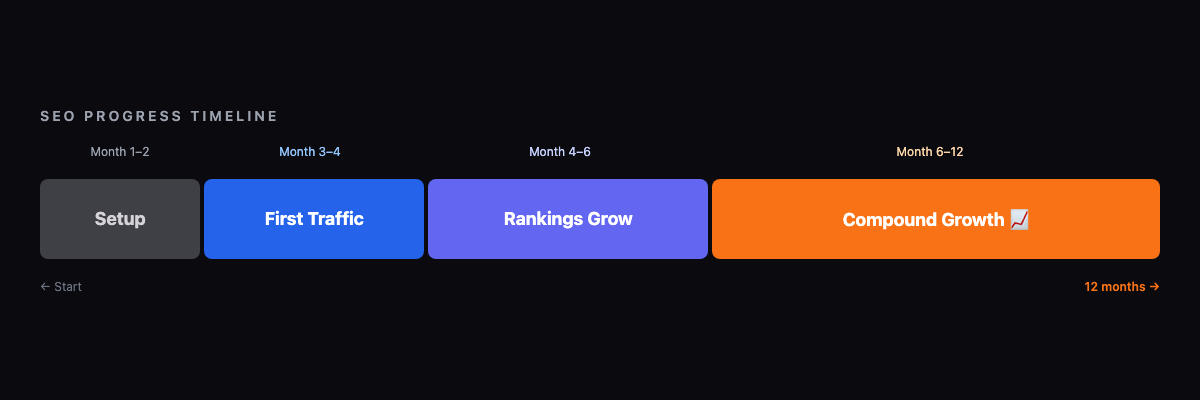
Time it takes for SEO to show compound growth for a small business starting from scratch
Here's what realistic progress looks like:
- Month 1–2: Technical fixes, Google Business Profile setup, initial content
- Month 3–4: First signs of organic traffic. You start appearing for long-tail keywords (specific, less competitive searches)
- Month 4–6: Traffic grows as content gets indexed and starts ranking. You might hit page 1 for some local searches
- Month 6–12: Compound growth. Each new piece of content and each new backlink builds on the previous work
The businesses that win at SEO are the ones that keep at it for 6–12 months. Most quit after 2 months because they don't see instant results. That's the gap you can exploit by being patient.
Should you do it yourself or hire someone?
If you have 3–5 hours a week and you're willing to learn, you can handle the basics yourself: Google Business Profile, writing blog posts, directory listings. The technical stuff (site speed, structured data, sitemap configuration) is where most business owners get stuck.
Hiring an agency makes sense when your time is worth more than the agency fee. If you bill $150/hour and you'd spend 10 hours a month on SEO, paying an agency $500–1,000/month is a good trade.
SEO packages from $500/month — technical work, content, and monthly reporting included. Book a free call to discuss what SEO can do for your business.